There’s a reason most homeowners don’t think about their air conditioner until it stops working: nobody wants to spend money on something that seems fine. The problem is, by the time it’s not fine, you’re comparing quotes under pressure, in triple-digit heat, with no real sense of what a fair price even looks like.
This guide fixes that. Below, you’ll find what AC maintenance actually costs in the Mesa area, how often it’s genuinely worth scheduling, what you’re paying for on a service call, and a simple way to tell when a repair still makes sense – and when it doesn’t.
Quick answer: A standard AC tune-up in Mesa runs $75–$200 per visit. Annual maintenance plans (two visits a year) typically cost $120–$360. Diagnostic service calls run $75–$200, usually credited toward any repair. Read on for the full breakdown.
How much should an AC service cost?
A standard AC tune-up runs $75–$200 per visit, with most homeowners paying between $100–$150 for routine service: filter inspection, coil check, refrigerant level test, electrical connection review, and an overall performance check. Prefer to stay ahead of it year-round? A maintenance plan covering two visits annually (pre-summer and pre-fall) typically runs $120–$360, depending on coverage.
Costs climb when a system is older, overdue for service, or needs a deeper coil and drain-line cleaning. A residential tune-up that catches a dirty coil early almost always costs less than the emergency call that follows once it’s ignored.
How often should your AC unit be serviced?
Once a year, ideally in spring, before your system has to run flat-out through a Mesa summer. That said, if your unit is over 10 years old, sits somewhere dusty, or runs nearly nonstop from May through September – which describes a lot of homes here – a second check in the fall is a smart move, not an upsell. It’s often the difference between a $150 fix caught in October and an emergency repair in the middle of August.
Skipping maintenance doesn’t actually save money. It just defers the cost – and turns a planned $150 visit into an unplanned bill that’s two or three times larger.
What is the average cost of an HVAC service call?
A service call – a technician diagnosing what’s wrong – typically runs $75–$200. That fee generally covers the diagnostic visit itself, not parts or labor for the fix. Most companies will credit it toward the repair if you move forward, so it’s worth confirming that policy before you book.
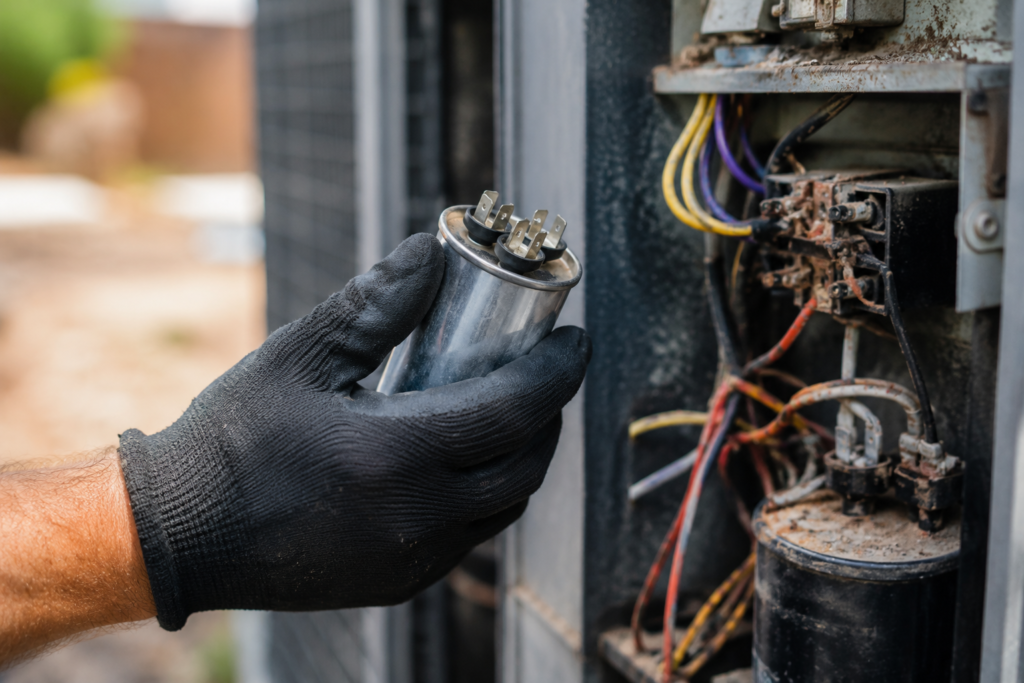
If the culprit turns out to be something common, like a failing capacitor, the fix itself is relatively affordable. Capacitor replacement is one of the most frequent repairs in Arizona for exactly this reason – our heat cycles these components harder than almost anywhere else in the country.
What is the $5,000 rule for AC?
It’s a quick formula HVAC professionals use to help homeowners weigh repair against replacement: multiply your AC’s age in years by the repair cost. Cross $5,000, and replacement typically wins financially. Stay under it, and repair is usually still the smarter move.
Two examples make it concrete:
- 6-year-old AC, $450 repair → 6 × 450 = 2,700 → repair makes sense.
- 12-year-old AC, $600 repair → 12 × 600 = 7,200 → replacement is the better long-term investment.
Treat it as a useful starting point, not gospel. A technician running proper diagnostic testing on your actual system can tell you whether the math holds up once they’ve seen the unit’s real condition – not just its age on paper.
Cheap vs. quality AC maintenance: what actually matters
The lowest quote isn’t automatically the best value. A rushed 20-minute visit that skips the coil cleaning and a real look at your ductwork isn’t maintenance – it’s a filter swap with a receipt attached. What you actually want is a technician who opens the unit, checks refrigerant pressure, tests the electrical components, and tells you the truth about your system’s condition, even when that means nothing needs fixing.
The real comparison was never $90 versus $150. It’s paying for maintenance now, on your schedule, versus paying for a breakdown later, on the AC’s schedule – almost always during the hottest week of the year.
Bottom line: Routine maintenance costs a fraction of what a breakdown does, and the earlier a small issue is caught, the cheaper it stays. If you’re unsure whether your system needs a tune-up or something more involved, our guide on when to maintain vs. when to call for repair breaks down the warning signs. Or skip the guesswork – call (480) 761-3217 and we’ll give you a straight answer on what your system actually needs.
Leave a Reply